
Long Copr builds now get stronger builders automatically
Assigning high-performance builders used to be manual. You asked us, we configured it. That is now automatic for packages that are known for having long build times. You can still request them manually when you need a guaranteed setup.
Behind it is rpmeta (RPM Estimated Time of (build) Arrival): a small model that estimates how long a build will take. If Copr expects roughly two hours or more on a normal builder, the job goes to a stronger machine instead.
What rpmeta is
rpmeta is an XGBoost model that learns from Copr builds how long packages usually take. The model and training data are published on Hugging Face.
If a package name is completely new to the model, Copr keeps it on a normal builder rather than guessing. In that situation, you still need to request the high-performance builders manually.
How Copr uses it
Before a builder is allocated, Copr asks rpmeta for an ETA. Predictions of higher than a certain threshold get a high-performance builder. Shorter builds stay on the normal pool. Existing manual assignments are left alone as rpmeta only adds a stronger builder when needed, it never takes one away.
We do not put every build on a high-performance machine on purpose. Those builders are expensive, limited in supply, and take longer to start than the normal pool, so short builds would often wait more than they would gain. See the pros and cons in the docs.
What the model thinks about common packages
Here is a sample of predictions from the production service for well-known
Fedora packages, assuming a normal Copr x86_64 builder. Anything at or above the
green line would get a high-performance machine today. On x86_64, that is an AWS
c7a.8xlarge
with 32 vCPU and 64 GB RAM:
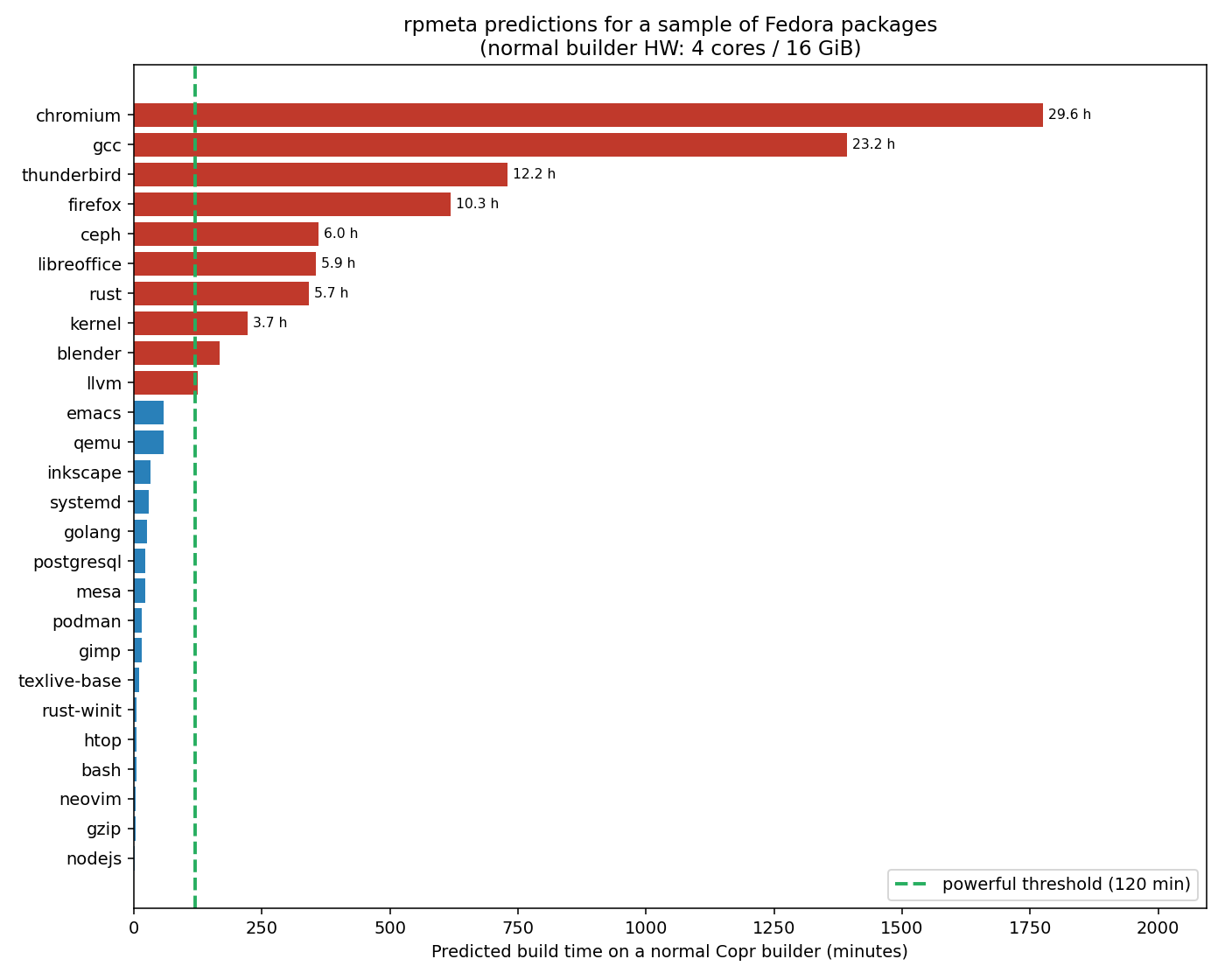
Browsers and large toolchains dominate the long end, which matches the packages people used to ask us about by hand. Common packages stay comfortably under the threshold.
Looking back at real Copr history
Here is per-chroot build history for a few heavy packages:
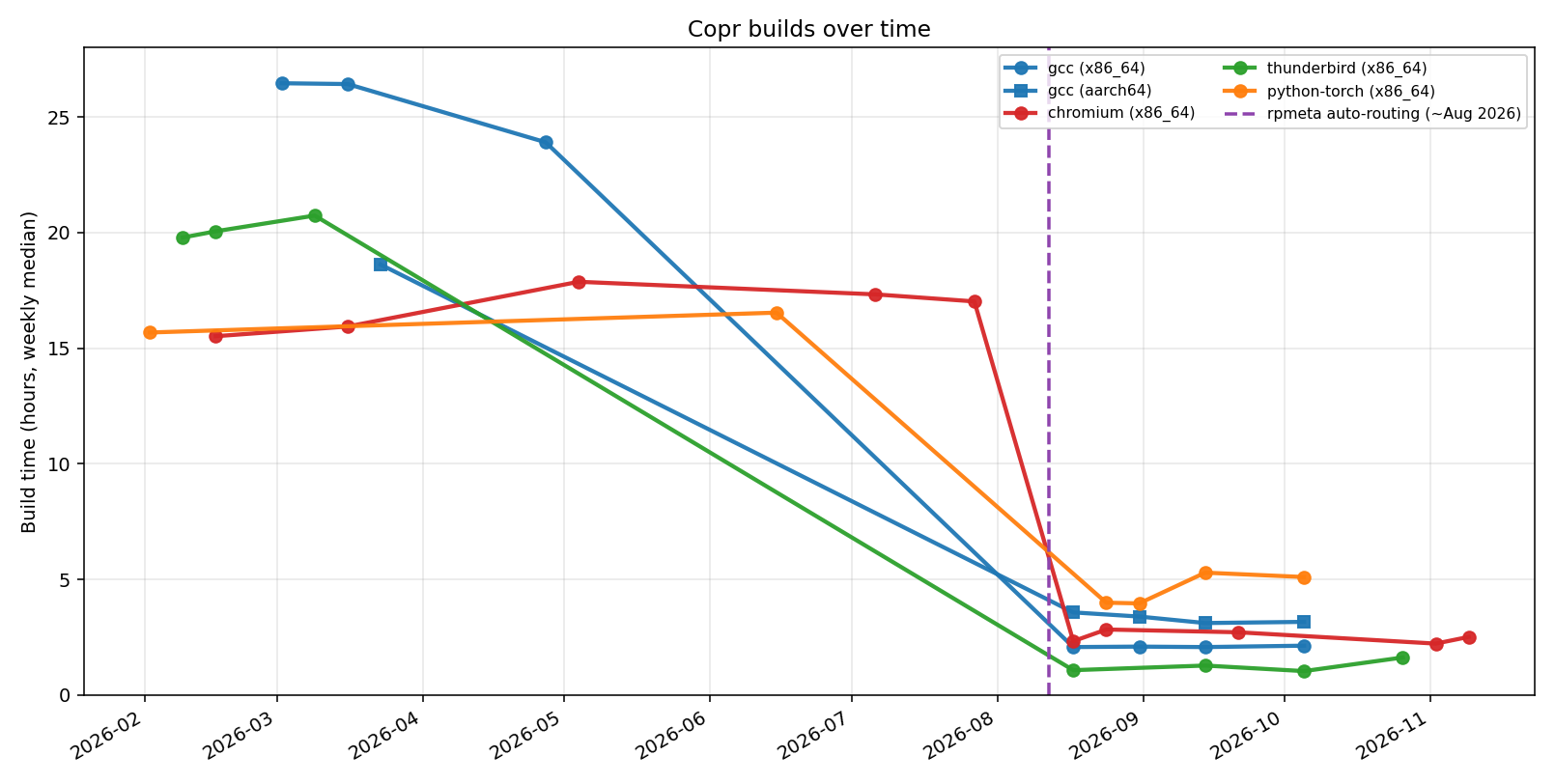
Once rpmeta auto-routing kicked in (~August 2026), those multi-hour builds dropped to a couple of hours on high-performance machines.
What this means for you
If you maintain a package that usually takes several hours on Copr, you probably do not need to ask us anymore since August as rpmeta should pick a stronger builder automatically once the package is known to the model.
If something is still stuck on a slow machine, the package is brand new to the model, or you want a guaranteed high-performance setup for a specific project, the manual request path is still available.
Looking ahead
rpmeta is only as good as the build history behind it. Today that is mostly
wall-clock duration with package information with basic hardware facts. We are
also working on a better Mock system_monitor
that collects CPU, memory, I/O and related metrics across the whole build.
Once Copr starts gathering that data, future versions of rpmeta may get a
much clearer picture of which builds are truly heavy, and which builders fit
them best.